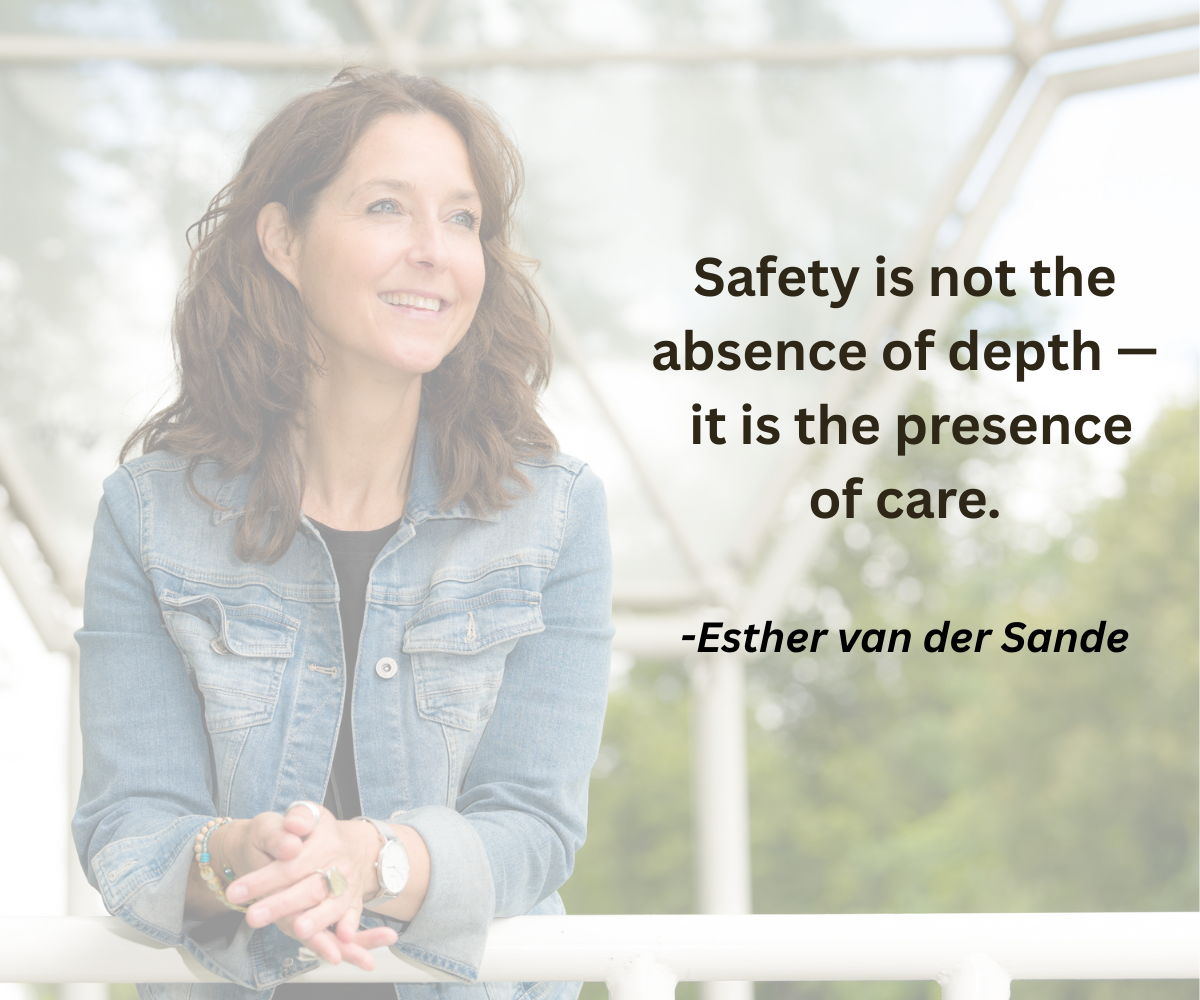
Open Sharing Circles: When Connection Calls for Care
On safety, responsibility, and trauma-sensitive practice in yoga and community spaces
In recent years, I’ve seen more and more open sharing circles emerge within yoga, mindfulness, and community spaces. I understand the longing behind them, the wish to feel connected, to be seen and to be heard, to not carry difficult experiences alone.
And at the same time, I notice a growing need to pause and reflect.
Not to dismiss these spaces.
Not to discourage openness.
But to add something essential: care, containment, and responsibility.
Whenever we work with people, we are not only working with what is visible.
We are also working with your nervous system, your history, and your capacity, whether these are spoken or not.
Why open sharing circles can feel so powerful
For many people, a sharing circle feels like a place of safety.
A place where you can finally put words to something that has lived quietly inside you for a long time.
A place of belonging.
That matters.
And precisely because it matters, it can also be tender.
When sharing becomes more than you can comfortably hold
What I often see in practice is that sharing can move faster or deeper than your body can integrate.
Not because you are doing anything wrong, but because your system (that is your body) opens, without enough support.
You may notice that you:
- feel emotionally overwhelmed
- freeze or drift away
- struggle to re-ground afterwards
- experience shame or regret after sharing
These are not signs of weakness.
They are natural stress and trauma responses of your nervous system.
This is where a quiet tension can arise:
when a space begins to feel therapeutic, without the skills, structure, or aftercare to truly support what has opened.
Yoga can be deep — but depth does not automatically mean safety
Yoga can open a lot.
Your body, your breath, and your attention are powerful gateways.
And yet, yoga is not the same as therapeutic work.
A yoga teacher can be deeply present, skilled, and caring, and still not be trained to work with trauma responses.
That is not a failure.
It is a professional boundary.
Risk arises when that boundary gently, quietly dissolves:
- when sharing is encouraged without clear choice
- when something opens without support to softly close again
- when the facilitator senses “this is big,” but doesn’t quite know how to respond
Good intentions alone are not always enough.
What trauma-informed practice means to me
Trauma-informed work is not a checklist.
It is a way of being with you.
It means:
- understanding that safety is something we keep creating together
- respecting your choice and consent (you never have to share)
- honouring your pace and your capacity
- noticing your nervous system’s signals
- using language that invites rather than directs
It also means shifting the goal.
Not toward emotional release, but toward regulation and integration.
So that you leave not “more open,” but more present in yourself.
Why somatic counselling skills are so important
Somatic skills allow us to work with what is happening right now in your body.
They help us notice:
- are you still here, or are you starting to drift?
- what is happening in your breath, muscle tone, or tempo?
And they offer ways to:
- slow things down
- help you come back to the present moment
- set boundaries without shaming
- restore a sense of safety when intensity rises
This is not about going deeper into your story.
It is about holding what arises with care.
What a safer sharing circle needs
A safer sharing space is supported by simple, clear structures, such as:
- a shared understanding that sharing is not therapy
- explicit consent — you never have to speak
- no advice-giving, fixing, or analysing
- gentle time boundaries
- a facilitator who stays present and responsive
- grounding and closure at the end
- awareness of aftercare if something remains open
One of the most important skills here is,… the ability to set limits with warmth and respect.
Why I’m sharing this with you
I’m not writing this to correct or judge anyone.
I’m writing because I believe that tenderness and professionalism can exist side by side.
You don’t have to share everything to be authentic.
Sometimes the most caring choice is to hold something privately and still remain connected.
About our trainings
If you work with groups where personal experiences are shared, additional training can make a real difference.
Trauma-Informed Yoga Therapy Training offers ethical frameworks and awareness.
Applied Somatic Counselling Skills offer practical tools for working with your nervous system and the nervous systems of others, in real time.
Not to turn you into a therapist, but to help you work more clearly, safely, and grounded within your own role.
If this resonates and you find yourself holding space for others, I invite you to pause with a gentle question:
What does this space need in order for you, and the people in it, to truly feel safe?
And if you feel drawn to deepen your understanding of trauma-sensitive or somatic work, I’m here to share more, in a way that respects your pace, your practice, and who you are.
With care,
Esther
esther@esthervandersande.com










Leave A Comment